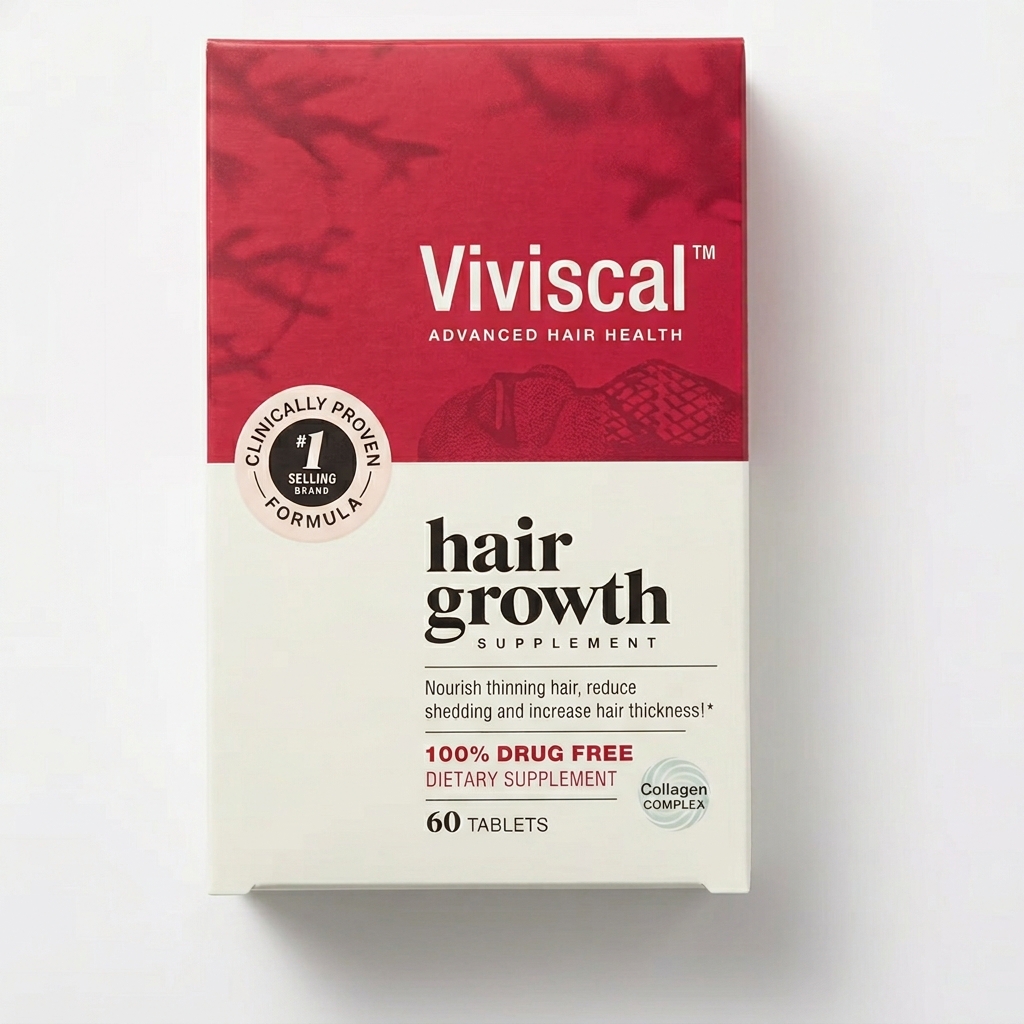
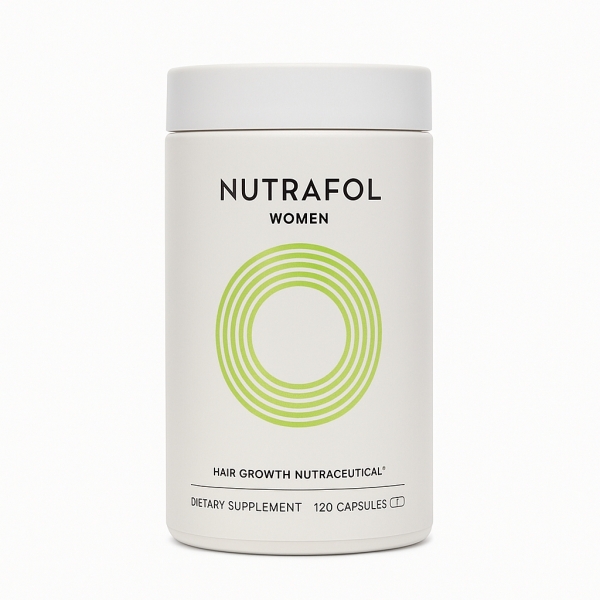
Nutrafol Women's Hair Growth Supplements, Ages 18-44, 120 Capsules vs Viviscal, Hair Growth Supplement, 60 Tablets: Multivitamin Comparison

Nutrafol Women vs Viviscal: Multi-Targeted Synergen Complex® or AminoMar™ “Heavy Artillery” for Shedding?

Nutrafol Women vs Viviscal — Bioavailability-First vs Evidence-First Hair Growth

Hair Growth Ages 18-44

Nutrafol Women is a broad, multi-target hair nutraceutical built around Synergen Complex® plus a second blend, aiming to cover multiple “root causes” (stress adaptation, DHT sensitivity, inflammation, oxidative stress, nutrition). It’s closer to a comprehensive hair system than a single-ingredient play: hydrolyzed marine collagen, Sensoril® ashwagandha, saw palmetto, curcumin, tocotrienols, plus amino acids/keratin support. On the label side it also uses more “form-conscious” minerals (e.g., zinc as zinc amino acid chelate and selenium as selenium amino acid chelate), which often helps on bioavailability scoring. The key advantage is that it has a 6-month double-blind, placebo-controlled study (Nutrafol Women Capsules) showing significant increases in terminal and vellus hair counts at day 90 and day 180 vs placebo, plus improvements in investigator-rated hair quality and patient-reported outcomes, with no reported adverse events. Trade-off: proprietary blends mean the exact sub-ingredient doses are not fully transparent, so it’s harder to attribute “what did the work.”

Hair Growth Supplement

Viviscal is a focused, hair-first formula centered on AminoMar™ marine complex (450 mg per tablet) taken twice daily for 3–6 months. It’s less of a “whole-body hair multivitamin” and more of a targeted regimen designed to hit the shedding/thinning problem directly. Viviscal’s clinical footprint is unusually strong for a supplement category: placebo-controlled human trials of the marine protein supplement report improvements in objective hair metrics and reduced shedding in women with self-perceived thinning hair. That’s why Viviscal typically leads in Hair Evidence scoring—especially on shedding outcomes—while Nutrafol competes more on broader coverage and multi-target positioning. Key constraints are non-negotiable: it contains marine allergens (fish/shark and mollusks), includes iron (important for households with children and for anyone avoiding extra iron), and is labeled not for pregnancy/nursing or under 18.

Bottom line: Choose Nutrafol if you want a broader multi-target approach with more form-conscious minerals and a 6-month DB-RCT supporting terminal/vellus hair count improvements. Choose Viviscal if your main complaint is shedding/diffuse thinning and you want the more concentrated, evidence-forward “hair artillery” approach—assuming marine allergens and iron cautions are acceptable.

Ingredient Breakdown
Supplement Facts for Nutrafol Women's Hair Growth Supplements, Ages 18-44, 120 Capsules
price category: 👑 Luxury
index bioavailability:
3.68
Supplement Facts for Viviscal, Hair Growth Supplement, 60 Tablets
price category: ⚖️ Standard
index bioavailability:
3.17
Usage & Audience
Serving Size
4 Capsules
1 Tablet
Servings Per Container
30
60
Audience
Women 18-44 yrs
Adults 18+ yrs
Pricing
Price
Price Per Serving
$2.93
$0.62
Price Updated At
03/01/2026 (Amazon US)
Chelated Minerals Overview Details below
Minerals total43
Pure chelates
20
Mixed chelates
00
Non-chelated
23
Contains chelate (any)20
Chelate coverage50%0%
Purity within chelated50%0%
Hair Evidence Overview Details below
Hair evidence score 34.00 75.00
Shedding (washed hair count) No data Strong
Terminal hair count (phototrichogram) Strong Strong
Vellus hair count (phototrichogram) Strong 🟡 Some
Hair thickness/diameter No data No data
Hair self-assessment / QoL 🟡 Some 🟡 Some
Base Ingredients
Bioavailability Legend: ?SuperiorHighUp. MediumMediumVariableLow-MidLowVery low
Ingredient
Nutrafol
Hair Growth Ages 18-44
Amount
Per
Serving
%
Daily
Value
Bio-
availability
Level
Viviscal
Hair Growth Supplement
Amount
Per
Serving
%
Daily
Value
Bio-
availability
Level
Vitamin C
100 mg 111% High
59 mg 65% High
Vitamin B3
Ø Absent
12 mg NE 75% High
Protein
1 g Variable
Ø Absent
Biotin
3000 mcg 10000% High
120 mcg 400% High
Vitamin A
1500 mcg RAE 167% Medium
Ø Absent
Calcium
Ø Absent
60 mg 5% Low
Vitamin D
62.5 mcg 313% High
Ø Absent
Iron
Ø Absent
10 mg 56% High
Vitamin E
3.5 mg 23% High
Ø Absent
Iodine
225 mcg 150% Medium
Ø Absent
Zinc
25 mg 227% High
11 mg 100% Very low
Selenium
200 mcg 364% Variable
Ø Absent
Sodium
5 mg <1% High
Ø Absent
Extra Ingredients
Aminomar™ Marine Complex
Ø Absent
450 mg Medium
Horsetail
Ø Absent
36.7 mg Variable
Millet
Ø Absent
7.5 mg Variable
Synergen Complex®
1.68 g Variable
Ø Absent
Nutrafol® Blend
530 mg Variable
Ø Absent
Other Ingredients
Other Ingredients
Ø Absent
<1 g <1%**
Symbol Decoding
Symbol Decoding
Ø Absent

Aspect Comparison

Positioning & Use-Case
Aspect Nutrafol Women's Hair Growth Supplements, Ages 18-44, 120 Capsules Viviscal, Hair Growth Supplement, 60 Tablets
Target / Use-Case
Target use-case (positioning) - Primary: women ages 18–44 with self-perceived thinning / increased shedding. - Strategy: combined approach (stress + DHT sensitivity + inflammation/oxidative stress + nutrient support + structural builders). - Not a general multivitamin: hair-focused formula with proprietary blends.
C confirmed
Target use-case (best-fit based on label + trial populations): • Adults with self-perceived hair thinning / increased shedding, especially “diffuse thinning” profiles. • Users who want a hair-focused supplement with published placebo-controlled evidence (3–6 months use). Less direct fit: • Users seeking DHT/hormone-targeting botanicals (none here). Hard exclusions (label): • Pregnant/nursing; under 18; seafood allergy (fish/mollusks).
B likely
Primary Mechanisms
Primary mechanism map (no promises) - DHT-modulation support: saw palmetto (plausible; dose unknown). - Stress/cortisol support: ashwagandha (plausible; dose unknown). - Inflammation/oxidative stress: curcumin + tocotrienols + resveratrol (standardized markers disclosed; doses unknown). - Structural support: marine collagen + keratin + sulfur amino acids (cysteine/methionine/lysine). - Nutrient repletion: high biotin + zinc/selenium + vitamin D (fully disclosed).
C likely
Mechanism map (no promises; based on label + clinical outcomes): • Core lever: marine protein/collagen complex (Aminomar) linked in RCTs to reduced shedding and improved hair metrics. • Shedding lever: reduced shedding over ~3 months in RCTs; may imply follicle-cycle shift (inferred from outcomes). • Fiber quality lever: small but significant increases in hair diameter reported in RCTs. • Nutrient support: iron + zinc + biotin + vitamin C (supportive, not a broad multivitamin). Boundaries / uncertainty: • Not positioned as DHT/hormone modulation. • Aminomar sub-component dosing is not disclosed → mechanism partly “black box” beyond observed endpoints.
C likely
Composition & Key Actives
Aspect Nutrafol Women's Hair Growth Supplements, Ages 18-44, 120 Capsules Viviscal, Hair Growth Supplement, 60 Tablets
Key Proprietary Ingredients
Key proprietary complexes (per daily serving) - Synergen Complex® (Patented): 1.68 g. - Nutrafol® Blend: 530 mg. - Individual ingredient doses inside these blends: Not disclosed.
C confirmed
Key proprietary ingredient: • Aminomar™ Marine Complex — 450 mg per tablet (900 mg/day). Label-listed components (within that line item): • Collagen Type II • Oyster extract powder Allergen context: • Contains fish (shark) and mollusks.
B confirmed
Dose Transparency
Dosage transparency - Full transparency: vitamins/minerals have explicit doses. - Partial transparency: blend totals are disclosed, but per-ingredient mg inside blends are proprietary. - Net: “Partial / Proprietary blend” (limits dose-to-evidence auditing).
C confirmed
Dosage transparency = PARTIAL. Disclosed clearly: • Vitamins/minerals mg/mcg. • Horsetail and millet extract mg. Partly opaque: • Aminomar™ is disclosed as 450 mg total, but component doses inside the complex are not disclosed.
B confirmed
Other Notable Nutrients
Other notable nutrients / label notes - Vitamin A is beta-carotene (not preformed retinol). - Vitamin C includes ascorbic acid + camu-camu fruit source. - Vitamin E listed as d-alpha tocopherol (dose modest vs DV). - Sodium 5 mg; calories 10; carbs 1 g; protein 1 g (minor).
C confirmed
Other notable label items: • Calcium: 60 mg per tablet (120 mg/day) — low contribution vs typical daily needs. • Horsetail extract: 36.7 mg per tablet (73.4 mg/day). • Millet seed extract: 7.5 mg per tablet (15 mg/day). • Total carbohydrate: <1 g per tablet (negligible). No additional amino acid “builders” (e.g., cysteine/methionine/lysine) are disclosed on this label.
B confirmed
Other Notable Nutrients
Notable nutrients for “hair context” (dose + form where disclosed) - Biotin: 3,000 mcg (very high; lab-test interference relevant). - Vitamin D3: 62.5 mcg (2,500 IU). - Zinc: 25 mg (as zinc amino acid chelate). - Selenium: 200 mcg (as selenium amino acid chelate). - Iodine: 225 mcg (from organic kelp).
C confirmed
Notable hair-relevant micronutrients (label): • Iron (ferrous fumarate): 10 mg per tablet (20 mg/day). • Zinc (zinc oxide): 11 mg per tablet (22 mg/day). • Biotin: 120 mcg per tablet (240 mcg/day). • Vitamin C (acerola + ascorbic acid): 59 mg per tablet (118 mg/day). • Niacin (niacinamide): 12 mg NE per tablet (24 mg/day). Note: zinc oxide is generally considered a lower-bioavailability zinc form vs chelates; label does not provide alternative forms.
B confirmed
Biotin Content
Biotin (per daily serving) - Amount: 3,000 mcg (10,000% DV). - Form: listed as “Biotin” (no specific form such as magnesium biotinate disclosed).
C confirmed
Biotin (label): • 120 mcg per 1 tablet. • 240 mcg/day at the recommended 2 tablets/day. Biotin form: • Not disclosed (listed simply as “Biotin”).
B confirmed
Structural Builders (Hair Shaft)
Structural “building blocks” for hair shaft/keratin (label) - Hydrolyzed marine collagen (peptides). - Keratin. - Sulfur amino acids: L-cysteine + L-methionine; plus L-lysine. - Horsetail extract (often positioned as a silica source; silica amount not disclosed).
C confirmed
Structural “builders” for hair shaft (what’s actually present): • Aminomar™ marine complex includes collagen/protein fractions (collagen type II; oyster extract powder listed). • Vitamin C supports collagen synthesis pathways (supportive, not hair-specific). • Horsetail is often used as a “silica” herb, but silica content is NOT disclosed/standardized here. Not present / not disclosed: • No explicit keratin, L-cysteine, L-methionine, L-lysine, MSM (not found on label).
C likely
Delivery & Bioavailability
Mechanism
Label Transparency
Evidence & Claims
Aspect Nutrafol Women's Hair Growth Supplements, Ages 18-44, 120 Capsules Viviscal, Hair Growth Supplement, 60 Tablets
Claimed Time to Results
Time-to-results claim (brand) - Brand messaging: best results with consistent daily use for ~3–6 months. - Note: this is a brand claim; biological plausibility for hair-cycle changes often requires months, but individual response varies.
D confirmed
Time-to-results claim (label): • Take for 3–6 months. • “May start seeing results in as little as 3 months”; 6 months recommended for thicker, fuller hair. Claim vs biology: • Hair-cycle timelines make a multi-month window plausible; short “weeks-level” promises are not the core claim here.
B confirmed
Clinical Evidence (end-product vs ingredient)
Clinical evidence (finished product vs ingredients) - Finished-product RCTs exist for Nutrafol women’s capsules (6-month randomized, double-blind, placebo-controlled trials in women with self-perceived thinning). - Important limitation: published disclosures indicate brand involvement/funding (see “Financial support… Nutraceutical Wellness, Inc.”), which reduces independence. - Formula drift risk: studies may not perfectly match the current label version; exact equivalence is not verifiable from label alone.
B confirmed
Finished-product evidence exists (placebo-controlled human RCTs) for Viviscal/AminoMar-based formulas. Key examples (women): • 3-month double-blind RCT: Viviscal Extra Strength (twice daily) increased terminal hair count and reduced shedding vs placebo (Ablon 2015). • 6-month multisite double-blind RCT: marine/AminoMar-based supplement reduced shedding and increased fine-hair diameter vs placebo (Rizer et al. 2015; PMC available). • 6-month double-blind RCT: “Viviscal Professional Strength” improved terminal hair growth and hair diameter vs placebo (Ablon et al. 2015; PMC available). Men: • 6-month double-blind RCT: Viviscal Man improved hair counts/density and reduced hair-pull shedding vs placebo (Ablon 2016). Limitations: • Manufacturer involvement/sponsorship is common across this evidence base; independent replication would strengthen confidence.
B confirmed
Independence / Sponsorship
Study independence / sponsorship - Published Nutrafol RCT literature includes explicit brand ties: author affiliation with Nutraceutical Wellness and “Financial support… Nutraceutical Wellness, Inc.” - Net: evidence exists, but independence is limited (brand-funded / brand-involved).
B confirmed
Study independence (bias risk): • Multiple placebo-controlled trials exist, but manufacturer involvement is common (e.g., trials explicitly identify Viviscal/Lifes2good; some include company-linked authors or funding). Practical interpretation: • Evidence is stronger than “ingredient-only marketing”, but not the same as fully independent replication across multiple unrelated teams.
B confirmed
Safety & Red Flags
Aspect Nutrafol Women's Hair Growth Supplements, Ages 18-44, 120 Capsules Viviscal, Hair Growth Supplement, 60 Tablets
Biotin: Lab Test Interference Flag
Biotin lab-test interference risk - Dose is high (3,000 mcg/day). High-dose biotin can interfere with some immunoassays (e.g., thyroid panels, cardiac troponin), causing falsely high/low results. - Practical note: disclose biotin use to clinicians/labs before bloodwork; pausing before testing should be clinician-guided.
B likely
Lab-test interference risk (biotin): • FDA warns biotin can interfere with certain lab tests (including troponin; also many immunoassays). Dose realism for THIS product: • At 240 mcg/day (recommended use), this is far below “high-dose biotin” regimens (often ≥5,000 mcg/day) most associated with clinically significant interference. Practical rule: • Risk is likely LOW at label dose, but disclose use before sensitive labs, especially if stacking other biotin products.
A likely
Thyroid Flag (Iodine/Kelp)
Thyroid flag (iodine/kelp) - Iodine is present: 225 mcg, sourced from organic kelp. - Relevance: users with thyroid disease/sensitivity (or on thyroid meds) should be cautious with kelp/iodine intake and discuss with clinician.
C confirmed
Iodine/kelp/seaweed flag: • No iodine or kelp/seaweed ingredients indicated on the Supplement Facts label. Not found on label.
B confirmed
GI Irritation Flag
GI irritation/tolerance flags - Piperine (black pepper extract) and capsaicinoids (cayenne) can be GI-irritating in sensitive users. - Curcumin/ botanical stack + 4 capsules/day may increase nausea/reflux risk for some. - Mitigation: take with a full meal; stop if persistent GI symptoms.
C likely
GI irritation flags: • No classic GI irritants/absorption boosters listed (no piperine/capsaicin). • Iron (ferrous fumarate) can cause GI effects in some users (nausea, constipation), especially if taken without adequate food. Net: mild GI risk mainly driven by iron sensitivity.
B likely
High-Dose Pressure (UL proximity)
Upper-limit (UL) pressure check (adults) - Selenium: 200 mcg/day vs UL 400 mcg → moderate (50% of UL). - Zinc: 25 mg/day vs UL 40 mg → moderate-high (62.5% of UL); long-term high zinc can affect copper balance (copper not provided on label). - Vitamin D: 62.5 mcg/day vs UL 100 mcg → moderate. - Iodine: 225 mcg/day vs UL 1,100 mcg → low-to-moderate. - Biotin: no established UL, but lab-test interference is the main practical risk at high doses.
B likely
Upper-limit (UL) pressure check at recommended 2 tablets/day: • Iron: 20 mg/day (adult UL = 45 mg/day) → below UL, but meaningful dose; stacking iron can push higher. • Zinc: 22 mg/day (adult UL = 40 mg/day) → below UL; stacking zinc can push toward UL. • Niacin: 24 mg NE/day; UL for niacin is 35 mg/day (note: UL is mainly based on flushing with nicotinic acid; niacinamide differs, but label uses niacinamide). Net: UL pressure = low-to-moderate, mainly relevant if the user stacks multiple multis/minerals.
A likely
Safety & Precautions
Safety precautions & red flags - Pregnancy/lactation: “Do not use if pregnant or nursing” (listing). - Allergy: contains fish (cod, haddock, pollock). - Biotin: high-dose biotin can interfere with lab tests (thyroid, troponin and others) → disclose before bloodwork. - Liver: a severe liver-injury case report/abstract linked Nutrafol use; causality is not guaranteed, but it is a meaningful caution—avoid if you have liver disease or are on hepatotoxic meds. - Drug interactions (plausible): saw palmetto/curcumin may interact with anticoagulants/antiplatelets in susceptible users (dose unknown; discuss with clinician).
B confirmed
Key safety / contraindications (label + high-quality safety guidance): Label warnings: • NOT intended for pregnant or nursing women; NOT for persons under 18. • Iron overdose warning for children: keep out of reach; seek urgent help in overdose. • If taking medications, consult a clinician before use. Allergen warnings: • Contains fish (shark) and mollusks (oyster) → avoid if seafood allergy. Iron-specific cautions (practical): • 20 mg/day iron at recommended use: consider avoidance/clinician guidance for men, postmenopausal women, hemochromatosis, or those already supplementing iron. Biotin / lab tests: • FDA warns biotin can interfere with some lab tests; this product’s biotin dose is low, but disclose supplement use before critical labs (especially if stacking biotin).
A confirmed
Practical Use
Cost & Value