
Bioavailability Index Score
4.25
Strong overall score, supported by L-5-MTHF folate, methylcobalamin B12, D3, natural vitamin E forms, high-BI chromium, zinc, selenium, boron, and Bio-Quercetin phytosome.
Life Extension Two-Per-Day is a high-potency multivitamin with a Bioavailability Index of 4.25. This review analyzes its Supplement Facts, active nutrient forms, 60/120 tablet and capsule variants, and key limitations such as magnesium oxide.
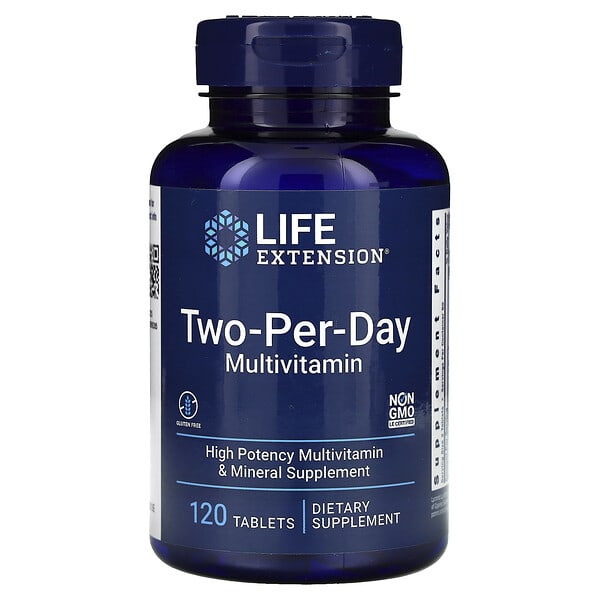
Fast product-level facts before the full review.
Strong overall score, supported by L-5-MTHF folate, methylcobalamin B12, D3, natural vitamin E forms, high-BI chromium, zinc, selenium, boron, and Bio-Quercetin phytosome.
The 120-tablet bottle provides 60 servings; suggested use is two tablets daily in divided doses with meals.
Life Extension Two-Per-Day is available as tablets and capsules in 60-count and 120-count variants; this BI block uses the provided 120-tablet Supplement Facts.
Based on the captured USD18.38 offer price and 60 servings per container; marketplace prices may change.
Provides vitamin D3 as cholecalciferol; the label advises serum 25-hydroxy vitamin D monitoring if total daily vitamin D intake exceeds 50 mcg.
Iron is not listed in the provided Supplement Facts, which matters for users specifically checking iron content.
Notable strong forms include L-5-methyltetrahydrofolate, methylcobalamin, cholecalciferol, natural vitamin E forms, zinc with L-OptiZinc, and Bio-Quercetin phytosome.
Boron and molybdenum use chelated or premium organic forms, zinc and selenium are mixed systems, while magnesium is magnesium oxide and rated Low.
Despite the strong overall BI, magnesium is supplied as magnesium oxide and receives a Low bioavailability rating in the provided analysis.
Full ingredient list with serving amounts, Daily Values, and bioavailability levels.
| Ingredient | Amount Per Serving | % Daily Value | Bioavailability Level | ||
|---|---|---|---|---|---|
| Vitamin A (as beta-carotene, acetate) (5,000 IU) | 1500 mcg^ | 167% | Up. Medium | ||
Up. Medium | |||||
| Vitamin C (as ascorbic acid, calcium and niacinamide ascorbates) | 470 mg | 522% | High | ||
High | |||||
| Vitamin D3 (as cholecalciferol) (2,000 IU) | 50 mcg | 250% | High | ||
High | |||||
| Vitamin E (as D-alpha tocopheryl succinate, D-alpha tocopherol) | 67 mg | 447% | High | ||
High | |||||
| Thiamine (vitamin B1) (as thiamine HCl) | 75 mg | 6250% | High | ||
High | |||||
| Riboflavin (vitamin B2) (as riboflavin, riboflavin 5'-phosphate) | 50 mg | 3846% | Up. Medium | ||
Up. Medium | |||||
| Niacin (as niacinamide, niacinamide ascorbate) | 50 mg° | 313% | High | ||
High | |||||
| Vitamin B6 (as pyridoxine HCl, pyridoxal 5'-phosphate) | 75 mg | 4412% | Up. Medium | ||
Up. Medium | |||||
| Folate (as L-5-methyltetrahydrofolate calcium salt) | 680 mcg° | 170% | High | ||
High | |||||
| Vitamin B12 (as methylcobalamin) | 300 mcg | 12500% | High | ||
High | |||||
| Biotin | 300 mcg | 1000% | High | ||
High | |||||
| Pantothenic acid (as D-calcium pantothenate) | 50 mg | 1000% | High | ||
High | |||||
| Iodine (as potassium iodide) | 150 mcg | 100% | High | ||
High | |||||
| Magnesium (as magnesium oxide) | 100 mg | 24% | Low | ||
Low | |||||
| Zinc (as zinc citrate, L-OptiZinc® zinc mono-L-methionine sulfate) | 25 mg | 227% | High | ||
High | |||||
| Selenium [as sodium selenite, SelenoExcell® high selenium yeast, Se-methyl L-selenocysteine] | 200 mcg | 364% | High | ||
High | |||||
| Manganese (as manganese citrate, gluconate) | 2 mg | 87% | Up. Medium | ||
Up. Medium | |||||
| Chromium [as Crominex® 3+ chromium stabilized with Capros® amla extract (fruit), PrimaVie® Shilajit] | 200 mcg | 571% | Superior | ||
Superior | |||||
| Molybdenum (as molybdenum amino acid chelate) | 100 mcg | 222% | High | ||
High | |||||
| Inositol | 50 mg | ** | High | ||
High | |||||
| Alpha lipoic acid | 25 mg | ** | High | ||
High | |||||
| Natural mixed tocopherols (providing gamma, delta, alpha, beta) | 20 mg | ** | High | ||
High | |||||
| Bio-Quercetin® phytosome (providing 5 mg quercetin [from Japanese sophora concentrate (flower bud)], phosphatidylcholine complex [from sunflower]) | 15 mg | ** | Superior | ||
Superior | |||||
| Marigold extract (Tagetes erecta)(flower)[std. to 5 mg trans-lutein, 155 mcg trans-zeaxanthin] | 11.12 mg | ** | High | ||
High | |||||
| Apigenin | 5 mg | ** | Low | ||
Low | |||||
| Boron (as boron amino acid chelate) | 3 mg | ** | High | ||
High | |||||
| Lycopene [from LycoBeads® natural tomato extract (fruit)] | 1 mg | ** | High | ||
High | |||||
| **Daily Value not established.^RAE (retinol activity equivalent). °DFE (dietary folate equivalent). •NE (niacin equivalent). | |||||
| Microcrystalline cellulose, stearic acid, croscarmellose sodium, dicalcium phosphate, food starch modified, silica, vegetable stearate, maltodextrin, coating (purified water, hypromellose, glycerin). | |||||
Life Extension Two-Per-Day Supplement Facts & Bioavailability Review: this is a high-potency multivitamin and mineral formula with a strong Bioavailability Index of 4.25.
The main strength is the use of several well-rated nutrient forms, including L-5-MTHF folate, methylcobalamin B12, vitamin D3, natural vitamin E forms, L-OptiZinc, SelenoExcell, Crominex 3+, Bio-Quercetin phytosome and LycoBeads lycopene.
The main limitation is not the overall formula quality, but specific gaps: magnesium is supplied as magnesium oxide and rated Low for bioavailability, while iron and calcium are not listed as separate Supplement Facts nutrients.
This review is based on the provided 120-tablet Supplement Facts. Life Extension also sells Two-Per-Day in tablets and capsules, in 60-count and 120-count variants, so users should compare the current label when choosing a specific bottle format.
Life Extension Two-Per-Day is available in tablet and capsule formats, with 60-count and 120-count bottle options. We compared the Supplement Facts across the 60-tablet, 120-tablet, 60-capsule, and 120-capsule versions. The active nutrient formula appears identical; the main difference is bottle size and delivery format.
| Variant | What changes | How to use this review |
|---|---|---|
| 120 Tablets | Tablet format, larger bottle | This is the exact variant analyzed on this page. |
| 60 Tablets | Same tablet formula, smaller bottle | The Supplement Facts appear identical to the 120-tablet version; only the count changes. |
| 120 Capsules | Same active formula, capsule format | The Supplement Facts appear identical to the tablet version; the difference is mainly delivery format and inactive ingredients. |
| 60 Capsules | Same capsule formula, smaller bottle | The Supplement Facts appear identical to the 120-capsule version; only the count changes. |
The Bioavailability Index on this page should be understood as an analysis of the Two-Per-Day active nutrient formula, not only of one bottle size. For the checked variants, the Supplement Facts appear identical, so the BI interpretation is the same. The practical choice is mainly about tablet vs capsule format, bottle size, price per serving, and availability.
The delivery-format differences between tablets and capsules are covered in the next section.
Life Extension Two-Per-Day is available in both tablet and capsule formats. Based on the compared Supplement Facts, the active vitamin and mineral formula appears identical, so the Bioavailability Index applies to the formula rather than only to the 120-tablet bottle.
The practical difference is mainly in the delivery format and inactive ingredients. Tablets are a compressed solid form, while capsules contain the formula inside a vegetable cellulose capsule shell. This does not automatically mean that one version is more bioavailable than the other; the active nutrient forms remain the key factor.
| Format | What is different | Who may prefer it |
|---|---|---|
| Tablets | Includes stearic acid, croscarmellose sodium, and a coating made with purified water, hypromellose, and glycerin. | Users who are comfortable with coated compressed tablets and do not mind standard tablet excipients. |
| Capsules | Uses a vegetable cellulose capsule shell instead of a tablet coating and disintegrant system. | Users who prefer capsule format or want to avoid the additional tablet coating and croscarmellose sodium. |
Both versions share several inactive ingredients, including dicalcium phosphate, modified food starch, silica, vegetable stearate, microcrystalline cellulose, maltodextrin, sunflower lecithin, and sunflower oil.
Bottom line: if the current labels remain identical, the choice between tablets and capsules is mostly about swallowing preference, tolerance of inactive ingredients, price, and availability — not about a different nutrient profile.
For a side-by-side SKU-level view, see the Life Extension Two-Per-Day 120 Capsules vs 120 Tablets comparison.
The provided Supplement Facts use a serving size of 2 tablets, with 60 servings per 120-tablet bottle. Suggested use is two tablets daily in divided doses with meals.
Important searchable dosage facts include vitamin D3 at 50 mcg / 2,000 IU, vitamin B12 as methylcobalamin at 300 mcg, zinc at 25 mg, selenium at 200 mcg, chromium at 200 mcg, magnesium at 100 mg, and folate as L-5-MTHF calcium salt at 680 mcg DFE.
Iron is not listed in the provided Supplement Facts. Calcium is also not listed as a separate Supplement Facts mineral, although calcium-containing compounds appear inside some ingredient forms and other ingredients.
The strongest part of the formula is the number of nutrients supplied in active, organic or enhanced forms rather than only basic commodity forms.
This form quality is the main reason the product performs better than many basic multivitamins that rely heavily on cheaper, less bioavailable forms.
The Bioavailability Index is 4.25, which is a strong score for a broad-spectrum multivitamin.
The score is supported by high-rated forms such as methylcobalamin B12, L-5-MTHF folate, vitamin D3, zinc with L-OptiZinc, selenium with SelenoExcell and Se-methyl L-selenocysteine, Crominex 3+ chromium, boron amino acid chelate, molybdenum amino acid chelate, and Bio-Quercetin phytosome.
The score is moderated by a few weaker or less ideal entries, especially magnesium as magnesium oxide and apigenin, which is rated Low in the provided analysis.
The mineral profile is mixed rather than uniformly premium. The provided chelated mineral overview lists 8 total minerals: 2 pure chelates or other premium organic forms, 2 mixed mineral systems, and 4 non-chelated minerals.
The clearest weakness is magnesium. It is supplied as magnesium oxide, provides 100 mg per serving, and receives a Low bioavailability rating. Users looking for a serious magnesium product should not treat this multivitamin as a complete magnesium solution.
The verified official evidence describes Two-Per-Day as a high-potency multivitamin and mineral supplement. The product description also positions it as a broad-spectrum formula with vitamins, minerals and additional nutrients.
Supported label signals include Gluten Free and Non-GMO LE Certified. No vegetarian claim, vegan claim, manufacturing claim or independent testing claim was provided in the verified evidence.
The product description mentions branded ingredients including L-OptiZinc, SelenoExcell, Crominex 3+, Capros, PrimaVie, Bio-Quercetin and LycoBeads. These are useful identification signals, but they should not be treated as proof of a clinical outcome by themselves.
The suggested use is to take two tablets daily in divided doses with meals, or as recommended by a healthcare practitioner.
The label warns not to exceed the recommended dose, to keep the product out of reach of children, and not to purchase if the outer seal is damaged. It also advises consulting a physician if undergoing treatment for a medical condition, or if pregnant or lactating.
Because the formula provides 50 mcg / 2,000 IU of vitamin D3, the label also advises periodic serum 25-hydroxy vitamin D measurement for individuals consuming more than 50 mcg of vitamin D per day from diet and supplements.
This product fits users who want a compact, high-potency multivitamin with a strong ingredient-form profile and a clear two-tablet daily serving.
It is especially relevant for users comparing multivitamins by Supplement Facts, ingredient forms, methylated B vitamins, zinc and selenium forms, vitamin D dose, and overall bioavailability rather than only by the number of ingredients on the label.
It is less suitable as a standalone solution for users specifically looking for iron, calcium, or a high-quality magnesium supplement, because those needs are either not covered as separate Supplement Facts nutrients or are covered with a weaker mineral form.
When comparing Life Extension Two-Per-Day with other multivitamins, the useful comparison points are not only the brand name or bottle size. The higher-value checks are:
For this specific 120-tablet version, the strongest comparison advantage is the form quality of many vitamins, zinc, selenium, chromium and antioxidant additions. The weakest comparison point is magnesium oxide.
The information provided on this website is for informational purposes only and is not intended as medical advice, diagnosis, or treatment. Always consult with a healthcare professional for any health-related questions or concerns.